

The history of the Black Country
The region that helped make the modern world: coal, iron, chain, glass and canals, and the communities who built them.
Where is the Black Country?
In the West Midlands, England, just west of Birmingham. Today it usually means most of the four boroughs of Dudley, Sandwell, Walsall and the City of Wolverhampton, about 138 square miles. There is no official boundary, and locals have long said that no two people agree exactly where it starts and ends.
Towns in the Black Country, borough by borough
Dudley
Dudley, Brierley Hill, Stourbridge, Halesowen, Sedgley, Netherton, Kingswinford, Coseley, Gornal, Lye, Wordsley, Quarry Bank
Local businesses in Dudley →Sandwell
West Bromwich, Oldbury, Tipton, Wednesbury, Smethwick, Rowley Regis, Blackheath, Cradley Heath, Old Hill
Local businesses in Sandwell →Is it in the Black Country?
- Where is the centre of the Black Country?
- Dudley and Tipton are generally thought of as its heart.
- Is Wolverhampton in the Black Country?
- Usually, yes. The City of Wolverhampton is one of the four boroughs normally counted, and in 1937 Arthur Mee called Wolverhampton the capital of the Black Country. Some traditionalists draw the line more tightly around Dudley.
- Is Walsall in the Black Country?
- Usually, yes. Walsall is one of the four boroughs, and it was firmly counted as Black Country through the 19th and early 20th centuries, though some traditionalists leave it out.
- Is Stourbridge in the Black Country?
- By borough, yes: Stourbridge is in Dudley. It sits on the southern edge, away from the coalfield, so some traditionalists leave it out, but the Bilston writer Samuel Griffiths included it as far back as 1876, and it was central to Black Country glassmaking.
- Is Halesowen in the Black Country?
- By borough, yes: Halesowen is in Dudley. Traditional definitions based on the coal seam include parts of it.
- Is Smethwick in the Black Country?
- Smethwick is in Sandwell. The Black Country Society includes it because it sits on the 30-foot coal seam, which was mined there from the 1870s.
- Is Birmingham in the Black Country?
- No. Birmingham is a separate city next door, and the Black Country's identity has long been defined partly in contrast to it.
Sources: Wikipedia: Black Country · BBC: What and where is the Black Country?
Five industries, one identity

Coal
The famous Thirty Foot seam — one of the thickest in Britain — lay close to the surface, fuelling everything else.
Iron & Chain
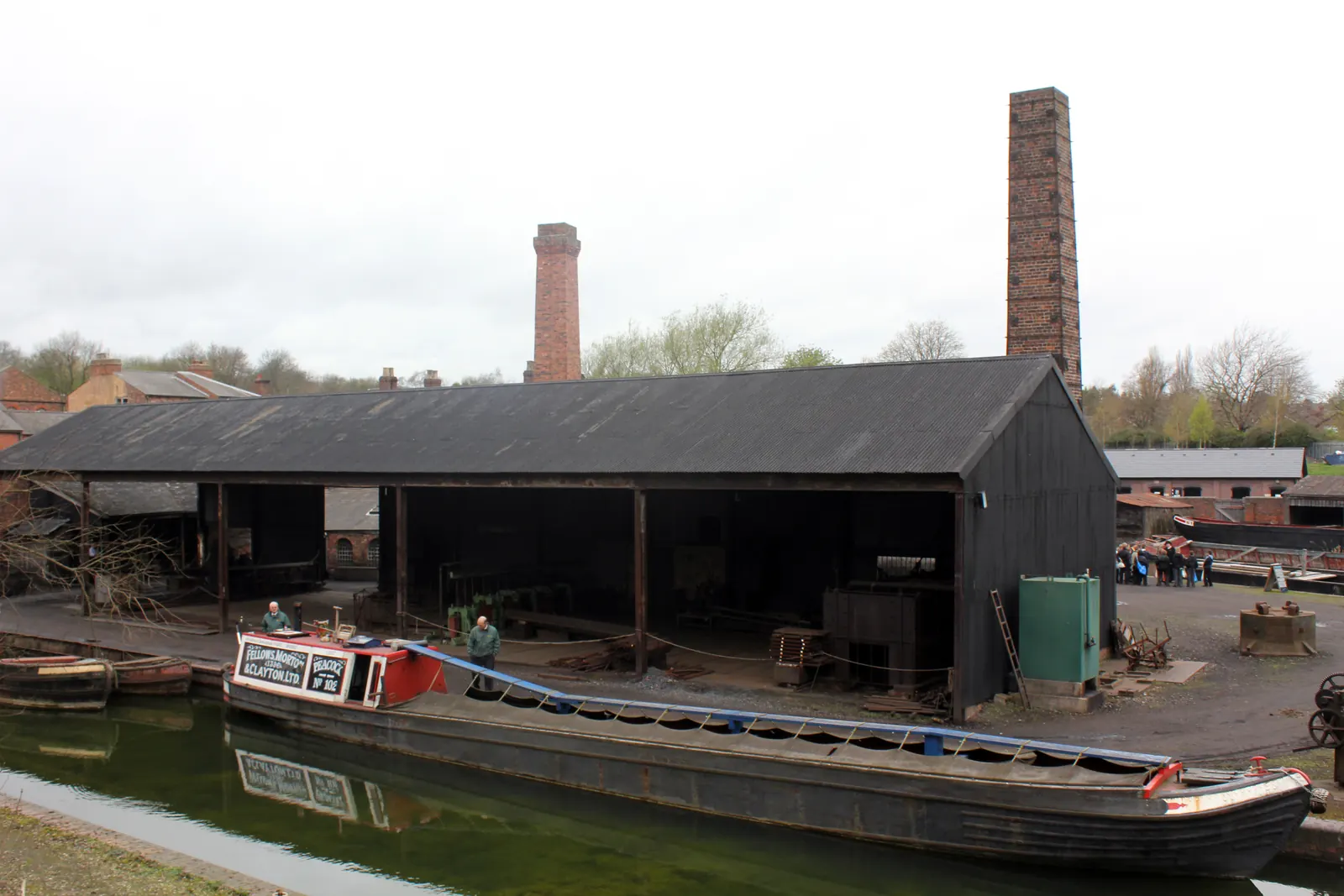
Small chain shops and giant works made the region the world's chainmaking capital, from ships' cables to everyday links. Chain is still made in Cradley Heath today, including for the Ministry of Defence.

Glass
Stourbridge crystal has been prized worldwide for centuries. Its glass cones gave the skyline its shape.

Canals
A dense network of canals linked mines, factories and markets, carrying coal, iron and glass far beyond the region.

Engineering & trades
Locks and keys from Willenhall, saddles and leather goods from Walsall, nails from cottage forges, and cars and bicycles from Wolverhampton: the region built things that worked.
From tropical sea to the present day
428 million years ago
A shallow tropical sea
Dudley lay under a warm, shallow sea south of the equator, full of coral reefs, sea lilies and trilobites. Their remains became the limestone of Wren’s Nest, where around 700 fossil species are known, including the trilobite nicknamed the Dudley Bug, which ended up on Dudley’s coat of arms.
See it: Wren's Nest National Nature Reserve →
About 310 million years ago
Steamy swamp forests
Now close to the equator, the area was covered in tropical swamp forests with trees up to 45 metres tall. Layer after layer of dead plants became coal, alongside the ironstone and fireclay that would one day fuel Black Country industry: 12 coal seams, 12 ironstones and 14 fireclays packed into less than 150 metres of rock.
See it: Dudley Museum at the Archives →About 307 million years ago
Molten rock pushes up
Earth movements folded the land and hot magma forced its way into cracks, cooling into the hard dolerite of the Rowley Hills, later quarried as ‘Rowley Rag’ for roads.
About 299–252 million years ago
Scorching deserts
As part of the supercontinent Pangaea, the region baked in hot, dry desert conditions.
About 2 million to 10,000 years ago
Ice ages
Ice sheets came and went, leaving behind the sands and gravels still found across the area. Coral seas, swamps, deserts and ice: over 430 million years of change is why the Black Country became a UNESCO Global Geopark.
994
Wulfrun's town
Lady Wulfrun grants land to the church in Wolverhampton. The town grows around it and takes her name: Wulfrun's heantun, Wulfrun's high farm. A few places, including Wolverhampton, Bilston and Wednesfield, appear in Anglo-Saxon charters and chronicles.
1086
Dudley in the Domesday Book
Dudley and its castle are recorded — the hilltop has watched over the region for nearly a thousand years.
See it: Dudley Castle →
1100s–1200s
Market towns, a priory and an abbey
Under the Normans a castle and priory are built at Dudley, and Halesowen Abbey is founded in the early 1200s. Dudley, Walsall and Wolverhampton grow from villages into market towns.
1560s
The first blast furnace
The first recorded blast furnace in the Black Country is built at West Bromwich. With coal, ironstone and limestone all close to the surface, metalworking takes hold.
Early 1600s
Glassmaking comes to Stourbridge
Glassmakers settle around Stourbridge, drawn by local fireclay that is perfect for the pots glass is melted in. It is the start of four centuries of Stourbridge glass.
1620s
A land of nailers and smiths
Around 20,000 smiths of all kinds are said to be working within ten miles of Dudley Castle. Many families farm a small plot and make nails at home to earn extra.
1642
Arming the King
When the Civil War begins, the region supplies Charles I: shot from Stourbridge, cannon from Dudley, and sword blades and pike heads from small forges along the brooks.
1712
The first successful steam engine
Thomas Newcomen’s atmospheric engine begins pumping water from the Coneygree coal mine near Dudley Castle — a breakthrough that changes industry.
See it: Black Country Living Museum →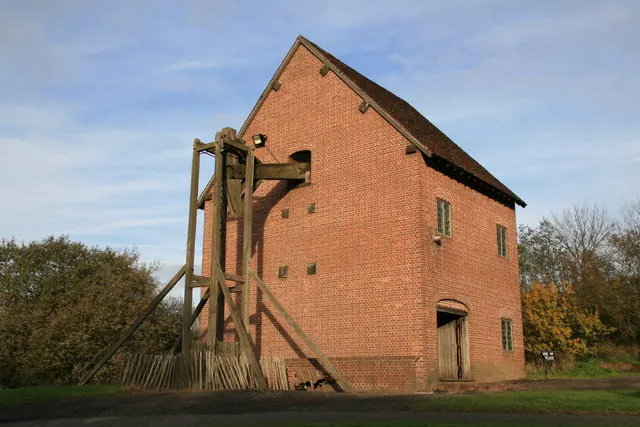
Mid-1700s
Bilston enamels
Bilston becomes famous for enamelling, making small decorated boxes for snuff and beauty patches that are still collected today.
1757
Iron made with coke
John Wilkinson starts making iron with coke instead of charcoal at Bradley, near Bilston. Ironworks spread rapidly across the region.
1768–1772
The canals arrive
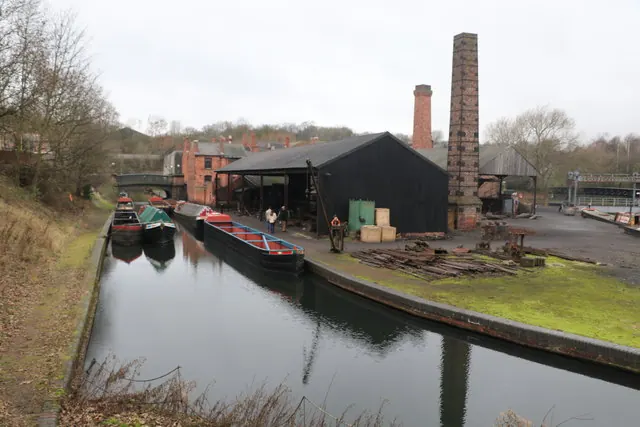
James Brindley builds a canal from Birmingham through the heart of the Black Country, linking it to the Staffordshire and Worcestershire Canal. Coal and iron can now travel far and cheaply.
1788–1794
The Red House Glass Cone is built
Richard Bradley builds the 100-foot Red House Cone at Wordsley, first for window glass. It makes glass until 1936 and is now one of the most complete glass cone sites in Europe.
See it: Red House Glass Cone →1792
Dudley Canal Tunnel opens
Canals link mines, furnaces and markets. The Black Country becomes a web of waterways.
See it: Dudley Canal & Caverns →
1841–1846
The name appears
The first recorded use of “black country” is a toast at a Lichfield meeting in 1841, describing Wolverhampton, Bilston and Tipton. In 1846 a novel calls it “the Black Country” as if everyone already knew the name.
1862
Black by day, red by night
American writer Elihu Burritt describes a landscape darkened by industrial smoke and glowing with furnaces at night — words that became closely associated with the region.
See it: Black Country Living Museum →1863
The peak of iron
There are 200 blast furnaces across the Black Country, with 110 of them working. Two years later there are more than 2,100 puddling furnaces turning pig iron into wrought iron.
1910
The women chainmakers
Led by Mary Macarthur, the women chainmakers of Cradley Heath win the first minimum wage in Britain after a ten-week strike.
See it: Mushroom Green Chain Shop →1911
Titanic’s anchor leaves Netherton
Noah Hingley & Sons assemble Titanic’s 16-ton centre anchor and make more than a thousand feet of chain. Up to 20 horses help haul the anchor towards the railway.
See it: Bumble Hole Local Nature Reserve →1913
The great tube strike
Starting at a Wednesbury tube works on 9 May, more than 40,000 workers across the Black Country strike for two months and win a minimum weekly wage of 23 shillings, the same as in Birmingham.
1968
The last pit closes
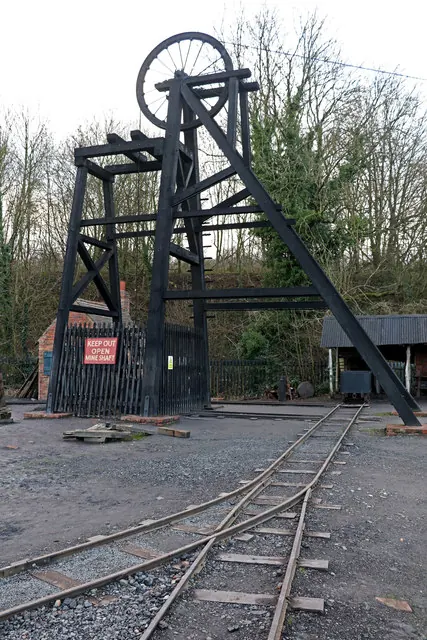
Baggeridge Colliery near Sedgley closes on 2 March, ending around 300 years of mass coal mining in the Black Country.
1973
The Black Country Bugle
The Black Country Bugle starts in Cradley Heath, collecting readers' memories and local history. It is still published every week.
1978
The Living Museum opens
Buildings saved from across the region are rebuilt brick by brick in Dudley.
See it: Black Country Living Museum →1979–1982
The steelworks close
Big employers close one after another, including Bilston Steel Works, Patent Shaft in Wednesbury and Round Oak at Brierley Hill. Unemployment in Brierley Hill passes 25%. The Round Oak site later becomes Merry Hill shopping centre, built between 1985 and 1990.
1987
The name becomes official
The Black Country Development Corporation is set up to regenerate Sandwell and Walsall, the first official use of the name.
1989
An electric furnace at Stuart Crystal
The Stuart Crystal factory in Stourbridge replaces its old pot furnaces with a continuous electric melting furnace for its lead crystal, running from August 1989 and saving energy.
2009
A Black Country tartan
Philip Tibbetts from Halesowen designs the Black Country tartan, the first of the region's modern symbols to be registered.
2012
A flag for the region
Gracie Sheppard's design wins a competition and is registered as the official Black Country flag.
See it: Red House Glass Cone →2020
A UNESCO Global Geopark
In July 2020 the Black Country is recognised as a UNESCO Global Geopark, for 430 million years of geology and the industry it made possible.
See it: Wren's Nest National Nature Reserve →
2022
Stourbridge Glass Museum opens
On 9 April 2022 the Stourbridge Glass Museum opens at the former Stuart Crystal works in Wordsley, across the road from the Red House Cone, telling 400 years of local glassmaking.
See it: Stourbridge Glass Museum →
2024
Glass goes electric
By July 2024 Stourbridge Glass Museum has a new hot glass studio with an electric furnace running on renewable energy and solar panels. Run by Allister Malcolm Glass, it is described as a world first, and the museum's resident artists make their glass with it.
See it: Stourbridge Glass Museum →2025–2026
Awards for greener glass
The electric studio helps the museum become joint Sustainable Project of the Year at the Museums + Heritage Awards 2025. In March 2026 it wins gold at the West Midlands Tourism Awards for regenerative tourism.
See it: Stourbridge Glass Museum →
Geology from the Black Country UNESCO Global Geopark and the Black Country Geological Society; history from Wikipedia: Black Country; the electric glass studio from AIM and the National Lottery Heritage Fund. Photographers and licences are listed on Photo credits.